

- A unified, omnichannel customer journey
- Full customer data integration
- Seamless, engaging and positive customer experiences

See a more detailed specification
About the integration
The Voyado Engage integration with SFCC (called a Cartridge in Salesforce terminology) needs to be deployed, installed and configured in the customer’s Salesforce environment. After the SDK license agreement is signed, the client will get access to the source code on Github, together with a guide on how to install the Cartridge. This installation requires technical skill and is not as simple as just installing an app. This integration is classed as an SDK, which means it can be extended and modified by the customer to support functionality outside of the implemented scope. However, bear this in mind: The Voyado Engage cartridge is also not compatible with PWA (Progressive Web App) storefronts. While some of the integration components could be used, the majority of the features have to be integrated into a PWA storefront separately, as the architecture is completely different to SFRA (Storefront Reference Architecture).What’s included
Here is the functionality that is currently supported: Contact creation: Contacts can be stored as two contact types (Member and Contact) or just one (Member). Contact updates: Contacts are synced in both directions, from SFCC to Engage and also in the other direction. Promotions: Promotions can be manually created in Engage and then assigned and connected to a promotion in SFCC. Web activity tracking: Abandoned cart tracking/recovery and product views are supported. Order confirmation email: An order confirmation email is triggered when an order is placed. Soft identification: The storefront can identify customers that arrive through an email send-out. Country and store mapping: The most common setup by merchants using SFCC is to connect a storefront to a specific country which means that in checkout, you are limited to shipping products within the country/countries you have set up for your site. In Engage, country and store mapping is defined by inputing a fallback store and mapping the rest of your Engage stores using a JSON structure.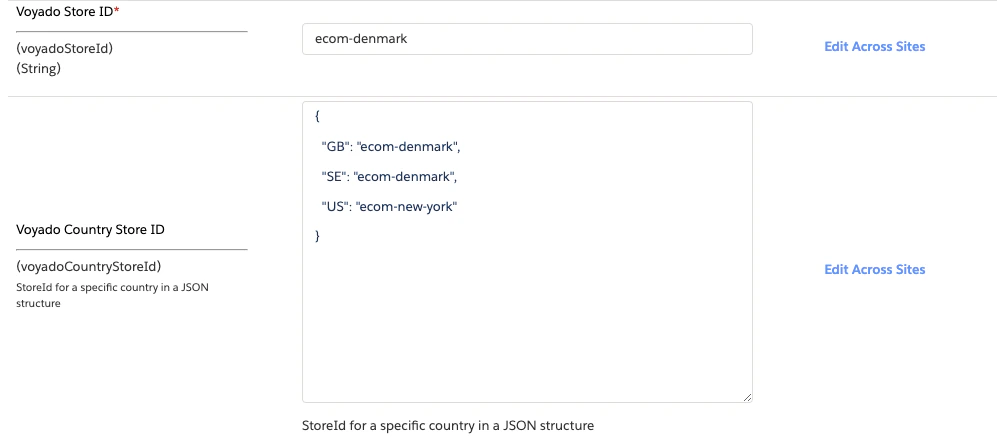
Country and store mapping